
Receiving your interview notice for the Reno or Sacramento field office is a milestone, but the letter itself is often a simplified version of reality. While it lists the date and time, it misses the local “boots on the ground” logistics that can make or break an application.
At Hughes Law Group, we navigate these hallways daily. We see where applicants stumble, not because of their eligibility, but because of logistical technicalities. If you want to walk into your Green Card or citizenship interview with the confidence of an insider, you need to look past the standard forms.
Can I use my child or a family member as an interpreter?
No. USCIS strictly prohibits using family members, friends, or your attorney as interpreters during the interview. To avoid delays or a rescheduled appointment, you must provide a disinterested, certified interpreter who is fluent in both languages and understands technical immigration terminology to ensure legal accuracy.
Interpreters: Who is Strictly Prohibited from Translating?
One of the most common reasons interviews in the Sacramento and Reno offices get rescheduled is the Interpreter Trap. Many applicants assume that because a spouse or adult child is fluent in English, they can help.
The Reality: USCIS policy requires an objective third party. Using a relative creates a conflict of interest in the officer’s eyes. Furthermore, an interpreter isn’t just “translating words”; they are translating legal testimony. If your interpreter doesn’t know the specific legal nuance of a “waiver” or “inadmissibility,” a simple mistranslation can lead to a formal denial.
Expert Tip: Secure a certified interpreter well in advance. In the Reno and Sacramento offices, officers expect interpreters to conduct themselves professionally. Bringing a pro shows the officer you are serious and prepared.
NOTE: It’s also important to understand that USCIS has the authority to immediately disqualify an interpreter if it believes the person is biased, not fluent enough, or could compromise the integrity of the interview. Certain individuals are outright prohibited, including minors under 18, parties interested in the case, and even your attorney or legal representative. In practice, even if a family member is technically allowed in some situations, officers often reject them if there’s any concern about impartiality. This unpredictability is exactly why relying on a professional interpreter is the safest choice.
The Digital Dilemma: Should You Rely on Tablets or Paper?
The Sacramento field office has moved toward a more digital-friendly environment, allowing for evidence uploads. However, relying solely on the “cloud” is a high-stakes gamble.
We often see a “Digital Disconnect”: an applicant uploads a new birth certificate or updated tax returns to the portal the night before, assuming the officer will see them on their screen. They often don’t. System lags or notification delays mean the officer might be looking at an outdated file.
The “Insider” Rule: Always bring physical copies of every new document. If the officer says, “I don’t see the 2025 tax returns here,” and you can’t hand them a physical paper, that’s the end of the conversation for that day.
Updated and Additional Documents:
For marriage-based cases, the initial submission may need to be updated with recent documents in support of the marriage. Don’t assume that the initial submission was sufficient, especially if it was submitted many months ago. It may be necessary to bring updated documents in support of the marriage, such as:
- Recently filed taxes in both names
- Updated bank statements
- Updated lease agreements or mortgage statements
- Recent bills in both names
- Updated insurance policy documents in both names.
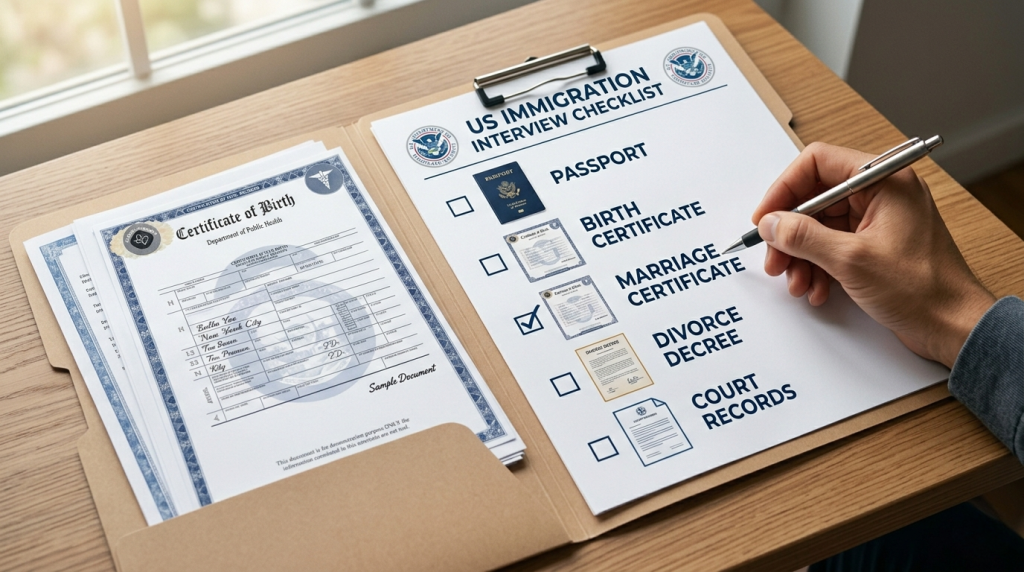
The Golden Rule of Originals: Your Essential Checklist
The mantra in immigration law is simple: If you sent a copy, bring the original. USCIS officers have the right to inspect the physical authenticity of any previously submitted document.
Use this quick checklist to ensure you aren’t sent home empty-handed:
- Birth Certificates: Original long-form certificates for the applicant, spouse, and children.
- Passports: All passports (expired and current) used to enter the U.S.
- Marriage Certificates: The original government-issued license (not the commemorative one from the chapel).
- Divorce Decrees: Original certified copies of all prior divorce judgments.
- Court Dispositions: If you have ever been detained or cited, you need original certified court records, even if the case was dismissed.
Review ALL Immigration History Prior to the Interview:
Recent trends at USCIS and consular processing indicate that officers are now carefully reviewing applicants’ entire immigration history, including prior visa applications submitted years earlier.
This means that any information previously provided, such as answers to security questions, prior immigration intent, or biographical details, may be revisited and compared against current filings. Even small inconsistencies can raise concerns and lead to delays or additional scrutiny. For this reason, it is increasingly important for applicants to thoroughly review their prior applications with counsel, make every effort to recall how questions were answered, and proactively address any discrepancies.
The most effective strategy in the current environment is preparation: understanding your full immigration record and ensuring consistency across all filings before appearing for an interview or submitting new applications.
Conclusion: Preparation is the Antidote to Stress
The USCIS interview isn’t just a test of your history; it’s a test of your preparation. The Reno and Sacramento offices run on specific, unwritten rhythms. By showing up with a professional interpreter, physical backups of your digital files, and an organized folder of original documents, you signal to the officer that your case is legitimate and ready for approval.
Don’t let a logistical oversight derail years of waiting.
[Schedule Your Free Screening Call]
Speak with our Intake Specialist today to ensure your logistics are as strong as your legal strategy.
FAQs: Local Logistics for Reno & Sacramento
1. What happens if my interpreter doesn’t show up to the Reno office?
If your interpreter is late or absent, the officer will likely reschedule your interview for a later date. This can add months to your wait time. It is always better to hire a reliable agency than to rely on an individual.
2. Can I show the officer evidence on my phone in Sacramento?
Technically, you can, but it is highly discouraged. Officers cannot take your phone behind the desk, and they cannot “print” from your device. If the evidence is important enough to show, it must be important enough to print.
3. Do I need the original of a document if I already uploaded a high-quality scan?
Yes. USCIS reserves the right to verify the physical security features (watermarks, seals, paper texture) of original documents. Failure to produce an original upon request may result in a Request for Evidence (RFE) or an immediate denial.
4. Should I bring photos?
For marriage-based interviews, photos of the wedding ceremony and reception can help even though they are considered secondary evidence. While officers may scan through 6-10 photos, it’s not necessary to bring multiple albums.
